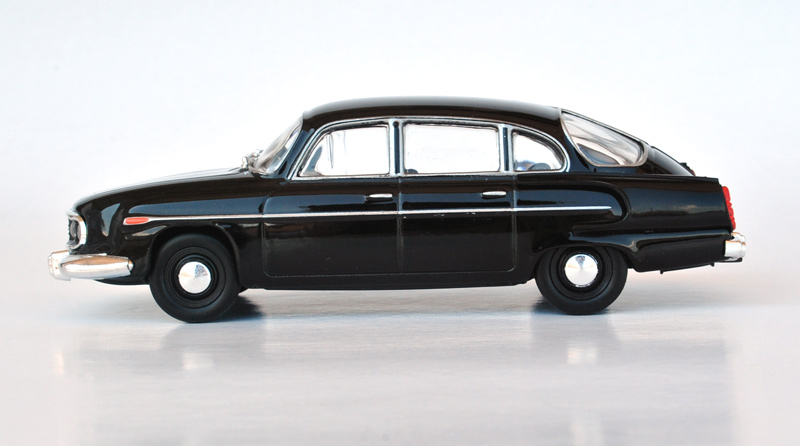
Tatra 613 este un automobil de lux produs de constructorul ceh Tatra intre 1974 si 1996, care a inlocuit seria Tatra 603. A beneficiat de o caroserie noua, conceputa de carosierul italian Vignale , si de doua motoare de 3.5 respectiv 4.3 litri. A suferit aproximativ 5 mici modificari de design de-a lungul perioadei de productie. Tatra 613 a fost indeosebi folosita de oficialitati dar si de serviciile publice.
Macheta este produsa de IST Models pt DeAgostini. Beneficiaza de o realizare reusita modelul avand toate accesoriile reproduse (lumini de ceata, oglinzi etc). Jantele sunt cromate si reproduse fidel, iar interiorul este complet negru. Stergatoarele sunt destul de fin realizate. Blocurile optice din spate sunt mai prost realizate, fiind din plastic mat rosu.
Tatra 613 (1974) - DeAgostini/IST Models
Tatra 613 is a luxury car built by the Czech manufacturer Tatra between 1974 and 1996, which replaced the old Tatra 603 series. It featured a new body design, drew by the italian designer Vignale, and 2 engines (3.5 and 4.3 liters). During its production lifetime, it had approximately 5 small design modifications. Tatra 613 was especially used by officials and by public services.
The scale model is produced by IST Models for DeAgostini. It is a well made model, with all details reproduced. The rims are chromed and replicated with fidelity, and the interior is all black with no decals. The wipers are fine. The rearlights are made out of matte plastic, unlike most models where they are made in transparent red plastic.
05 June, 2011
Tatra 613 (1974) - DeAgostini/IST Models
28 May, 2011
Tatra 603 (1968) - DeAgostini/IST Models
Tatra 603 a fost o limuzina de lux produsa in Cehoslovacia de catre compania Tatra. A facut parte dintr-o serie de limuzine produse de Tatra, serie care a pornit cu Tatra 77. In Cehoslovacia comunista, doar elita partidului si conducatorii marilor uzine aveau acces la o astfel de limuzina. Masina prezentata a facut parte dintr-o serie de 3 modele usor diferite a caror proiectare a inceput, in secret, in 1952. Dupa mai multe teste in tunelul aerodinamic s-a ales o forma finala a caroseriei, cu un design foarte avantgardist pentru acea perioada. Exista oarecare ambiguitati in ceea ce priveste anii de productie ai modelelor precum si diferitele modele, mai ales datorita faptului ca la un moment dat mai multe masini au fost intoarse in uzina si modificate, inclusiv la partea de design.
Macheta reproduce unul din modelele cu 4 faruri. Realizarea este in stilul machetelor de revista, mai multe accesorii optionale pe masina reala, lipsind. Printre acestea ar fi farurile de ceata, oglinzile, ornamente la roti. Vopseaua este frumos aplicata, foarte sensibila. Aerisirile laterale sunt realizate individual. Siglele si decalurile sunt ireprosabile si la aceasta macheta.
Tatra 603 (1968) - DeAgostini/IST Models
Tatra 603 was a luxury limousine produced in Czechoslovakia by the Tatra company. It was a part of a series of limo produced by Tatra, starting with Tatra 77. In the communist period, only the government elite and factories managers had access to such a car. This model was one of the 3 slightly different versions, whose designing started in 1952. After many tests in the wind tunnel, an aerodynamic shape was chosen, having a very futuristic design for that period.
The scale model replicates on of the models featuring 4 headlights. The model is made in the press models style, with some optional components ( mirrors, fog lights) missing. The decals and badges are perfect for this model.
Macheta reproduce unul din modelele cu 4 faruri. Realizarea este in stilul machetelor de revista, mai multe accesorii optionale pe masina reala, lipsind. Printre acestea ar fi farurile de ceata, oglinzile, ornamente la roti. Vopseaua este frumos aplicata, foarte sensibila. Aerisirile laterale sunt realizate individual. Siglele si decalurile sunt ireprosabile si la aceasta macheta.
Tatra 603 (1968) - DeAgostini/IST Models
Tatra 603 was a luxury limousine produced in Czechoslovakia by the Tatra company. It was a part of a series of limo produced by Tatra, starting with Tatra 77. In the communist period, only the government elite and factories managers had access to such a car. This model was one of the 3 slightly different versions, whose designing started in 1952. After many tests in the wind tunnel, an aerodynamic shape was chosen, having a very futuristic design for that period.
The scale model replicates on of the models featuring 4 headlights. The model is made in the press models style, with some optional components ( mirrors, fog lights) missing. The decals and badges are perfect for this model.
25 May, 2011
DeAgostini Updates
Cei de la DeAgostini Polonia si Ungaria au actualizat listele cu modelele urmatoare. Se intrevad modele interesante. Aro 240 pt cei care nu-l au inca, si care pare a fi un model imbunatatit, cu sigle puse corect, sau Nysa, care va aparea acum si in varianta de strada. O alta noutate este VW 1200, care dupa unele surse s-ar fi asamblat si prin Europa de Est. In Iugoslavia, parca.
Polonia:
Ungaria:
Polonia:
Ungaria:
21 May, 2011
Wartburg 311 Camping (1958) - DeAgostini/IST Models
Wartburg 311 Camping este varianta break/estate a masinii prezentata pe larg aici . Wartburg Camping a fost dezvoltat la aproximativ 2 ani dupa sedan.
Este cea de-a 3-a macheta Wartburg 311 din colectie. Mai lipseste una pt a avea colectia completa, din ce s-a produs la DeAgostini. Realizarea este asemanatoare cu celelalte doua. Este de laudat faptul ca au ales sa faca varianta cu ornamente albe, fara a merge pe o varianta simpla, poate mai ieftin de produs. Spatele este bine realizat, dar plasticul transparent ce tine loc de luneta este cam deplasat de la locul lui.
Wartburg 311 Camping (1958) - DeAgostini/IST Models
Wartburg 311 Camping is the estate version of the DDR car widely described here . It was developed approx. 2 years later after the sedan.
It's the third scale model of Wartburg 311 in my collection. One more to go and I have all of them. The quality is similar with the others. I like very much that they choosed to do the model in 2 colors instead of one. The rear part is well made, but a piece of plastic which stands for the window is a little misplaced.
Este cea de-a 3-a macheta Wartburg 311 din colectie. Mai lipseste una pt a avea colectia completa, din ce s-a produs la DeAgostini. Realizarea este asemanatoare cu celelalte doua. Este de laudat faptul ca au ales sa faca varianta cu ornamente albe, fara a merge pe o varianta simpla, poate mai ieftin de produs. Spatele este bine realizat, dar plasticul transparent ce tine loc de luneta este cam deplasat de la locul lui.
Wartburg 311 Camping (1958) - DeAgostini/IST Models
Wartburg 311 Camping is the estate version of the DDR car widely described here . It was developed approx. 2 years later after the sedan.
It's the third scale model of Wartburg 311 in my collection. One more to go and I have all of them. The quality is similar with the others. I like very much that they choosed to do the model in 2 colors instead of one. The rear part is well made, but a piece of plastic which stands for the window is a little misplaced.
27 March, 2011
Wartburg 353 Tourist (1981) - DeAgostini/IST Models
Cunoscut si ca Wartburg Knight, Wartburg 353 a intrat in productie in 1965, si a inlocuit gama Wartburg 311-312. S-a produs pana in 1988, iar in 1985 a primit un facelift si numeroase imbunatatiri. In Germania de Est, a fost intens folosit ca masina a serviciilor publice, in special in politie. Oamenii de rand care isi doreau aceasta masina asteptau pana la 15 ani pentru una. A avut succes la export, in deosebi in Marea Britanie, dar si in tarile din Blocul Estic in care s-a exportat. In Romania nu s-au importat, dar au ajuns multe la mana a doua, dupa '89. Modelul Tourist a fost dezvoltat la sfarsitul anilor '70, inainte de aplicarea faceliftului.
Macheta reproduce modelul dinainte de facelift, disponibil din 1965. Culoarea galben o prinde foarte bine. Ca realizare este reusita. Realizarea este la standaredele DeAgostini, oglinzi fara sticla, decaluri impecabile si jante foarte bine realizate. Interiorul nu prezinta nici o decoratie iar stopurile sunt monocolore.
s
Wartburg 353 Tourist (1981) - DeAgostini/IST Models
Wartburg 353, a.k.a. Wartburg Knight went in production in 1965, and replaced the Wartburg 31x range. It was produced until 1988, while in 1985 he got a face-lift and other improvements. In the East Germany was used as a public service car, especially by the Police. Ordinary people waited up to 15 years for one. It was a succes in exports, particularly in Great Britain, but also in the other Eastern Block cars. Romania did not imported them officially, but many got here after 1989. The estate version, named Tourist, was developed in the end on the '70s, before the facelift.
The scale model replicates the model before the facelift, which was available since 1965. The yellow color looks very good on this model. The realization is according to the DeAgostini standards, mirrors with no "glass", accurate decals, and very good made rims. The interior lacks any painted details and the backlights are monocolor which is ok for this model.
Macheta reproduce modelul dinainte de facelift, disponibil din 1965. Culoarea galben o prinde foarte bine. Ca realizare este reusita. Realizarea este la standaredele DeAgostini, oglinzi fara sticla, decaluri impecabile si jante foarte bine realizate. Interiorul nu prezinta nici o decoratie iar stopurile sunt monocolore.
s
Wartburg 353 Tourist (1981) - DeAgostini/IST Models
Wartburg 353, a.k.a. Wartburg Knight went in production in 1965, and replaced the Wartburg 31x range. It was produced until 1988, while in 1985 he got a face-lift and other improvements. In the East Germany was used as a public service car, especially by the Police. Ordinary people waited up to 15 years for one. It was a succes in exports, particularly in Great Britain, but also in the other Eastern Block cars. Romania did not imported them officially, but many got here after 1989. The estate version, named Tourist, was developed in the end on the '70s, before the facelift.
The scale model replicates the model before the facelift, which was available since 1965. The yellow color looks very good on this model. The realization is according to the DeAgostini standards, mirrors with no "glass", accurate decals, and very good made rims. The interior lacks any painted details and the backlights are monocolor which is ok for this model.
20 March, 2011
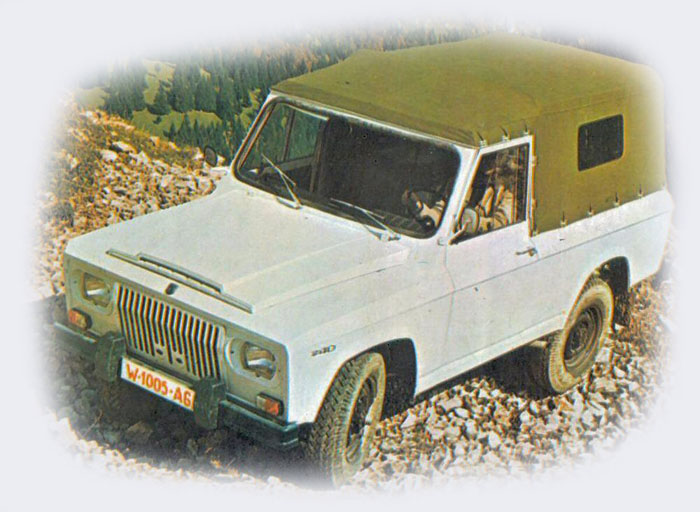
Aro 240 (1972) - DeAgostini/IST Models
Aro 240 a fost primul model din seria Aro 24, 0-ul de la sfarsit desemnand caroseria in 2 usi, deschisa, eventual acoperita cu prelata. A intrat in productie in 1972 si a fost produs pana la inchiderea uzinei, in 2006, avand mai multe imbunatatiri tehnice si estetice. Toata gama Aro 24 a suferit o multime de facelift-uri imprumutand de asemenea componente de la alte autovehicule romanesti. Odata, foarte comun, modelul exact reprezentat de aceasta macheta este unul extrem de rar astazi, daca nu chiar disparut in totalitate.
Macheta reproduce prima varianta a lui Aro 240, una dintre cele mai longevive ca perioada de productie. Este vorba de varianta cu grila frontala din metal, care s-a produs atat cu faruri dreptunghiulare cat si cu faruri rotunde. Aceasta este foarte bine reprezentata, avand orificiile grilei vopsite cu negru. Semnalizarile fac corp comun cu modelul dar sunt reprezentate prin decal-uri. Bara reproduce varianta cu tampoane mici, in realitate existand si o varianta cu tampoane mai mari, asemanatoare cu ale primei Dacii 1300. Pe bara este aplicat un nr de inmatriculare de Brasov . Pt aceasta macheta s-a optat pentru stergatoare incorporate in model, lucru care mi se pare destul de potrivt, acestea parand mai realiste, decat oarecare stergatoare aplicate, dar realizate mai prost. Prelata este din plastic, bine facuta, si se poate detasa. Interiorul este corect reprodus, fara decal-uri. Fiind vorba de primul Aro 240, stopurile sunt rotunde, in partea din spate mai gasindu-se si roata de rezerva aplicata pe un suport asemanator cu cel real.
Rotile sunt putin cam mari, si cred ar fi fost mai potrivite unele mai simple, de strada, iar o alta problema este culoarea, aceasta nefiind disponibila pe un model civil.
Aro 240 (1972) - DeAgostini/IST Models
Aro 240 was the first model of the Aro 24 series, the "0" from the end meaning the open 2 door body type, optionally covered with a canvas cover. It went in production in 1972 and was produced until the factory was closed, in 2006, suffering many esthetically and technical updates. All the Aro 24 range went through a series of facelifts, also borrowing items from other Romanian cars. Once very common, the model replicated by this miniature is very rare today, if not extinct.
The scale model replicates the first version of Aro 240, one of the longest time in production: the one with metal grille which was also produced with round headlights. The grille is very well made with the holes painted in black. The blinkers are one with the body but they are represented by decals. The bumper is well made, having a license plate registered in Brasov. For this model, the producer choose to make the wipers incorporated in the model, which i find very welcomed. The canvas cover is plastic, very nice made and detachable. The interior is correct, without any decoration. On the back side, the backlights are round, and we can see the spare wheel mounted onto a frame similar with the real one.
The wheels are a bit large, personally i think some street wheels would have been more suitable. The dark green color was available only for military vehicles.
Macheta reproduce prima varianta a lui Aro 240, una dintre cele mai longevive ca perioada de productie. Este vorba de varianta cu grila frontala din metal, care s-a produs atat cu faruri dreptunghiulare cat si cu faruri rotunde. Aceasta este foarte bine reprezentata, avand orificiile grilei vopsite cu negru. Semnalizarile fac corp comun cu modelul dar sunt reprezentate prin decal-uri. Bara reproduce varianta cu tampoane mici, in realitate existand si o varianta cu tampoane mai mari, asemanatoare cu ale primei Dacii 1300. Pe bara este aplicat un nr de inmatriculare de Brasov . Pt aceasta macheta s-a optat pentru stergatoare incorporate in model, lucru care mi se pare destul de potrivt, acestea parand mai realiste, decat oarecare stergatoare aplicate, dar realizate mai prost. Prelata este din plastic, bine facuta, si se poate detasa. Interiorul este corect reprodus, fara decal-uri. Fiind vorba de primul Aro 240, stopurile sunt rotunde, in partea din spate mai gasindu-se si roata de rezerva aplicata pe un suport asemanator cu cel real.
Rotile sunt putin cam mari, si cred ar fi fost mai potrivite unele mai simple, de strada, iar o alta problema este culoarea, aceasta nefiind disponibila pe un model civil.
Aro 240 (1972) - DeAgostini/IST Models
Aro 240 was the first model of the Aro 24 series, the "0" from the end meaning the open 2 door body type, optionally covered with a canvas cover. It went in production in 1972 and was produced until the factory was closed, in 2006, suffering many esthetically and technical updates. All the Aro 24 range went through a series of facelifts, also borrowing items from other Romanian cars. Once very common, the model replicated by this miniature is very rare today, if not extinct.
The scale model replicates the first version of Aro 240, one of the longest time in production: the one with metal grille which was also produced with round headlights. The grille is very well made with the holes painted in black. The blinkers are one with the body but they are represented by decals. The bumper is well made, having a license plate registered in Brasov. For this model, the producer choose to make the wipers incorporated in the model, which i find very welcomed. The canvas cover is plastic, very nice made and detachable. The interior is correct, without any decoration. On the back side, the backlights are round, and we can see the spare wheel mounted onto a frame similar with the real one.
The wheels are a bit large, personally i think some street wheels would have been more suitable. The dark green color was available only for military vehicles.
13 March, 2011
ZIL-131 "Pompieri" (1967) - Elecon
ZIL-131 este un camion de 3,5 tone cu tractiune integrala 6x6 produs in Uniunea Sovietica, respectiv Rusia pana prin 1994. A fost proiectat pt a fi folosit de serviciile publice, armata in special. Este baza mai multor echipamente militare rusesti: transport(bena sau prelata), telecomunicatii, cisterna, dar si pt lansatorul de rachete BM-51 "Prima". Pt uzul civil s-a proiectat ZIL-130, cele doua fiind foarte asemanatoare. Pt autospecialele de pompieri s-a introdus si o varianta cu cabina dubla.
Macheta este produsa in Rusia, de catre Elecon. Este destul de detaliata. Partea din spate este din plastic, la fel si echipamentele de interventii. Interiorul este facut corect dar este complet negru. Rotile sunt bine realizate. Sasiul este din metal si e foarte detaliat, axul cardanic si puntea spate cu cele 2 axe sunt mobile. Capota se deschide pt a expune motorul, care nu e foarte detaliat. Oglinzile sunt destul de finute si sunt facute dintr-un plastic moale, care nu se rupe, la fel ca si celelalte componente din plastic. Ca minusuri, ar fi vopseaua care nu e perfect aplicata, in cateva locuri avand aspect de coaja de portocala, si lampile din spate care nu sunt prea evidentiate.
ZIL-131 "Firemen" (1967) - Elecon
ZIL-131 is a 3,5 ton truck featuring 6 x 6 all wheel drive. It was produced in the Soviet Union (later Rusia) until 1994. It was designed for public service use, particulary ary forces. It's the base of several russian military equipement: flatbed transporter, radio, tanker but also for the BM-51 "Prima" rocket launcher. For civilian use a very similar ZIL-130 was designed. For firefighter trucks, a double cab was introduced.
The scale model is produced in Russia, by Elecon. It is quite detailed, the rear part being made from plastic and. The chassis and the cab is metalic. The interior is entire black and correctly made. The wheels are rubber, very well made, and the rear-double-axes are mobile. The engine bonnet can be opened, making the engine visible, altough not very detailed. The plastic parts are very soft and not easy breakable. It gets some bad marks at the paint job , and the rear lights which are not detailed.
Macheta este produsa in Rusia, de catre Elecon. Este destul de detaliata. Partea din spate este din plastic, la fel si echipamentele de interventii. Interiorul este facut corect dar este complet negru. Rotile sunt bine realizate. Sasiul este din metal si e foarte detaliat, axul cardanic si puntea spate cu cele 2 axe sunt mobile. Capota se deschide pt a expune motorul, care nu e foarte detaliat. Oglinzile sunt destul de finute si sunt facute dintr-un plastic moale, care nu se rupe, la fel ca si celelalte componente din plastic. Ca minusuri, ar fi vopseaua care nu e perfect aplicata, in cateva locuri avand aspect de coaja de portocala, si lampile din spate care nu sunt prea evidentiate.
ZIL-131 "Firemen" (1967) - Elecon
ZIL-131 is a 3,5 ton truck featuring 6 x 6 all wheel drive. It was produced in the Soviet Union (later Rusia) until 1994. It was designed for public service use, particulary ary forces. It's the base of several russian military equipement: flatbed transporter, radio, tanker but also for the BM-51 "Prima" rocket launcher. For civilian use a very similar ZIL-130 was designed. For firefighter trucks, a double cab was introduced.
The scale model is produced in Russia, by Elecon. It is quite detailed, the rear part being made from plastic and. The chassis and the cab is metalic. The interior is entire black and correctly made. The wheels are rubber, very well made, and the rear-double-axes are mobile. The engine bonnet can be opened, making the engine visible, altough not very detailed. The plastic parts are very soft and not easy breakable. It gets some bad marks at the paint job , and the rear lights which are not detailed.
10 March, 2011
Dacia 1300 (1969) - DeAgostini/IST Models
Dacia 1300 a aparut 1969 si a avut ca baza Renault 12. S-a produs in 2 variante usor diferite. Una "frantuzeasca" care era identica cu Renault 12 si una care avea tampoanele micsorate si prezenta lampi de marsaririer. Mai multe pe http://ro.wikipedia.org/wiki/Dacia_1300 . Masina asta chiar n-are nevoie de nici o prezentare pt romani.
Macheta, este produsa de IST Models pentru DeAgostini, si este primul numar al colectiei "Masini de legenda" aparute in Romania in data de 4 martie 2011. Ca si modelul real, macheta are la baza o matrita veche de Renault 12 care prezinta mici defecte de proprtii, cum ar fi de exemplu lungimea farurilor comparata cu cea a semnalizatoarelor. Oglinzile sunt tot aceleasi "urechi de Shrek". Jantele nu sunt chiar replica fidela a celor reale, dar seamana. Transformarea din Renault 12 in Dacia 1300 s-a facut prin schimbarea siglelor.
Dacia 1300 (1969) - DeAgostini/IST Models
Dacia 1300 was released in 1969 under a Renault 12 license. The name "Dacia" comes from the region were Romania is now. "1300" is the approximative engine displacement. The Dacia 1300 was produced in 2 slightly different version. One, called "The French", was 100% identical to Renault 12 and a later one, which had smaller rubbers bumpers, and featured white backlights. A pick-up and a estate version were also introduced. Dacia 1300 was updated to the Dacia 1310 in 1979.
The scale model was published by DeAgostini Romania, and it is produced by IXO/IST Models like all the models in the DeAgostini series. It is the first issue of the collection "Legendary Cars", released in Romania at 4 march 2011. Like the real model, the miniature is based onto a Renault 12 mold, which has some small errors of proportion. For example, the headlights which are to short compared to the blinkers. The mirrors are the same "Shrek ears". The rims are almost like the real ones.
Macheta, este produsa de IST Models pentru DeAgostini, si este primul numar al colectiei "Masini de legenda" aparute in Romania in data de 4 martie 2011. Ca si modelul real, macheta are la baza o matrita veche de Renault 12 care prezinta mici defecte de proprtii, cum ar fi de exemplu lungimea farurilor comparata cu cea a semnalizatoarelor. Oglinzile sunt tot aceleasi "urechi de Shrek". Jantele nu sunt chiar replica fidela a celor reale, dar seamana. Transformarea din Renault 12 in Dacia 1300 s-a facut prin schimbarea siglelor.
Dacia 1300 (1969) - DeAgostini/IST Models
Dacia 1300 was released in 1969 under a Renault 12 license. The name "Dacia" comes from the region were Romania is now. "1300" is the approximative engine displacement. The Dacia 1300 was produced in 2 slightly different version. One, called "The French", was 100% identical to Renault 12 and a later one, which had smaller rubbers bumpers, and featured white backlights. A pick-up and a estate version were also introduced. Dacia 1300 was updated to the Dacia 1310 in 1979.
The scale model was published by DeAgostini Romania, and it is produced by IXO/IST Models like all the models in the DeAgostini series. It is the first issue of the collection "Legendary Cars", released in Romania at 4 march 2011. Like the real model, the miniature is based onto a Renault 12 mold, which has some small errors of proportion. For example, the headlights which are to short compared to the blinkers. The mirrors are the same "Shrek ears". The rims are almost like the real ones.
04 March, 2011
Colectia de Machete DeAgostini - In Romania
Ieri, 4 martie 2011, a aparut in cateva orase din Romania (Galati, Cluj, Vaslui) revista "Masini de legenda" . Este vorba de varianta romaneasca a celor aparute in Rusia, Polonia, Ungaria, Cehia si vine in primul numar cu o macheta Dacia 1300. Urmatoarele vor fi Aro 240, Lada 1500, GAZ - M21 "Volga" , Trabant 601
Deocamdata este vorba despre un test de piata. Daca acesta va reusi, colectia va aparea in toata tara, la chioscurile de ziare.
27 February, 2011
Wartburg 353 (1985) - DeAgostini/IST Models
Cunoscut si ca Wartburg Knight, Wartburg 353 a intrat in productie in 1965, si a inlocuit gama Wartburg 31x. S-a produs pana in 1988, iar in 1985 a primit un facelift si numeroase imbunatatiri. In Germania de Est, a fost intens folosit ca masina a serviciilor publice, in general in politie. Oamenii de rand care is doreau aceasta masina asteptau pana la 15 ani pentru una. A avut succes la export, in deosebi in Marea Britanie, dar si in tarile din Blocul Estic in care s-a exportat. In Romania nu s-au importat, dar au ajuns multe la mana a doua, dupa '89. La mine in cartier (un cartier mititel) stiam 3 exemplare. Acum, putinele exemplare care n-au ajuns vouchere, se mai pot vedea in paragina prin parcarile dintre blocuri, rar cate unul in circulatie.
Macheta, din colectia DeAgostini, reproduce modelul cu facelift din 1985. Este frumos facut, cu exceptia farurilor. Nu stiu cat ar fi crescut costurile de productie ale machetei, daca spoiau un pic cu gri sau argintiu sub plasticul ala transparent, care tine loc de far. In rest, arata bine, jantele sunt bine replicate si perforate, inscriptiile sunt de nivel premium, foarte fin facute si lizibile. Stergatoarele sunt subtiri, lampile spate sunt doar rosii. Interiorul este negru complet, fara decaluri, iar oglinzile nu au "sticla". Imi place ca au replicat frumos scaunele, un model de tetiera care l-am vazut doar la Wartburg.
Wartburg 353 (1985) - DeAgostini/IST Models
Wartburg 353, a.k.a. Wartburg Knight went in production in 1965, and replaced the Wartburg 31x range. It was produced until 1988, while in 1985 he got a face-lift and other improvements. In the East Germany was used as a public service car, especially by the Police. Ordinary people waited up to 15 years for one. It was a succes in exports, particularly in Great Britain, but also in the other Eastern Block cars. Romania did not imported them officially, but many got here after 1989. Now, a small number of Wartburgg, which are not yet vouchers, can be seen abandoned in parking lots, and very few still working.
The scale model, from the DeAgostini collection, replicates the facelifted model from 1985. It is well made, except the headlights which look very strange, being placed over the beige paint. The rims are perforated and good replicated, the badges look premium, very fine made and easy readable. The wipers are thin, and the backlights are only in red. The interior is black with no decals. I like the well replicated seats with their unusual head-rest.
Macheta, din colectia DeAgostini, reproduce modelul cu facelift din 1985. Este frumos facut, cu exceptia farurilor. Nu stiu cat ar fi crescut costurile de productie ale machetei, daca spoiau un pic cu gri sau argintiu sub plasticul ala transparent, care tine loc de far. In rest, arata bine, jantele sunt bine replicate si perforate, inscriptiile sunt de nivel premium, foarte fin facute si lizibile. Stergatoarele sunt subtiri, lampile spate sunt doar rosii. Interiorul este negru complet, fara decaluri, iar oglinzile nu au "sticla". Imi place ca au replicat frumos scaunele, un model de tetiera care l-am vazut doar la Wartburg.
Wartburg 353 (1985) - DeAgostini/IST Models
Wartburg 353, a.k.a. Wartburg Knight went in production in 1965, and replaced the Wartburg 31x range. It was produced until 1988, while in 1985 he got a face-lift and other improvements. In the East Germany was used as a public service car, especially by the Police. Ordinary people waited up to 15 years for one. It was a succes in exports, particularly in Great Britain, but also in the other Eastern Block cars. Romania did not imported them officially, but many got here after 1989. Now, a small number of Wartburgg, which are not yet vouchers, can be seen abandoned in parking lots, and very few still working.
The scale model, from the DeAgostini collection, replicates the facelifted model from 1985. It is well made, except the headlights which look very strange, being placed over the beige paint. The rims are perforated and good replicated, the badges look premium, very fine made and easy readable. The wipers are thin, and the backlights are only in red. The interior is black with no decals. I like the well replicated seats with their unusual head-rest.
Subscribe to:
Posts (Atom)